Remote Monitoring of Vital Signs for The Development of Decision Support Systems in Medical Health Services
DOI:
https://doi.org/10.58190/ijamec.2025.156Keywords:
Clinical Alarms, Decision Support Systems, IoT Healthcare, Remote Patient Monitoring, Vital SignsAbstract
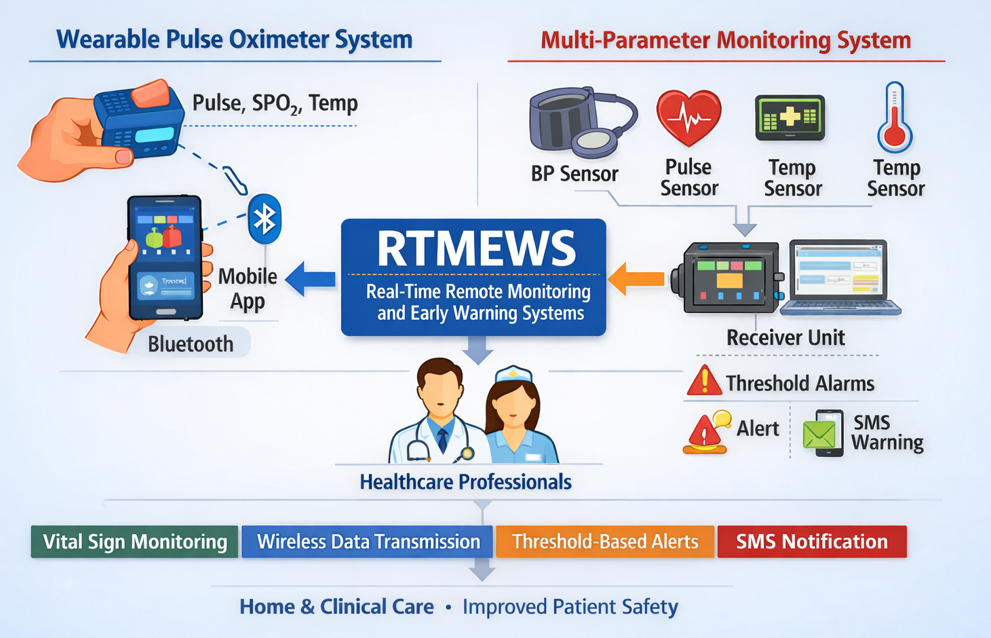
Monitoring patients' vital signs such as pulse, body temperature, systolic-diastolic blood pressure, and SpO₂ plays a significant role in healthcare systems for post-operative patients, emergencies, infants, individuals with heart failure, pandemics, and similar situations. In this study, two different real-time remote monitoring and early warning systems (RTMEWS) are proposed to assist healthcare professionals and physicians in measuring and monitoring patients' vital signs. In the first proposed RTMEWS, SpO₂, pulse, and body temperature can be measured using a pulse oximeter developed with an ATMEGA328P microcontroller and MAX30100 sensor, and monitored via wireless transmission from the OLED GLCD screen on the prototype through an interface developed with the MIT2 application on a smartphone. In the second proposed system, when the measured pulse rate, body temperature, and systolic-diastolic blood pressure findings exceed the threshold range determined by the physician, a warning message can be sent to the mobile phone of the healthcare worker, doctor, or desired recipient via an MC35i terminal (GSM/GPRS modem) controlled by an AT command set connected to the computer where the data is stored. In conclusion, many factors influence the determination of normal and abnormal ranges of vital signs and intervention priorities. When unforeseen situations arise in clinical care processes, RTMEWS has been shown to assist professional interventions by generating timely alarms. The system provides a foundation for clinical decision support systems by offering real-time remote monitoring and autonomous threshold-based alerts.
Downloads
References
[1] O. World Health. "Cardiovascular diseases (CVDs)." https://www.who.int/news-room/fact-sheets/detail/cardiovascular-diseases-(cvds) (accessed.
[2] R. Tan and W. Lim, "Embedded system design for portable medical devices," in IEEE EMBS Conference on Biomedical Engineering and Sciences, 2022 2022, pp. 234-239.
[3] Y. Ozturk, M. Yildirim, and T. Kaya, "IoT-based smart health monitoring system for chronic disease management," Journal of Medical Systems, vol. 46, no. 4, pp. 25-35, 2022.
[4] S. Lee and J. Choi, "Mobile health applications for chronic disease management," JMIR mHealth and uHealth, vol. 11, p. e40876, 2023.
[5] S. Ahmed and M. Hossain, "IoT-enabled smart healthcare: A systematic literature review," Computer Methods and Programs in Biomedicine, vol. 198, p. 105791, 2021.
[6] M. Khan and K. Salah, "Security and privacy in IoT-based healthcare systems," Journal of Network and Computer Applications, vol. 210, p. 103539, 2023.
[7] L. Chen, H. Wang, and Q. Zhang, "Real-time remote monitoring of vital signs using wearable sensors," IEEE Transactions on Biomedical Engineering, vol. 70, no. 5, pp. 1450-1462, 2023.
[8] M. Garcia and P. Rodriguez, "Real-time alert generation for critical health conditions," Journal of Biomedical Informatics, vol. 125, p. 103982, 2022.
[9] R. Singh, A. Patel, and S. Kumar, "Low-cost IoT-based patient monitoring system for home care," in IEEE International Conference on e-Health and Bioengineering, 2023 2023, pp. 1-6.
[10] M. Alshamrani, "A comprehensive review of IoT in healthcare: Applications and challenges," Internet of Things, vol. 19, p. 100567, 2022.
[11] F. Martinez and L. Gonzalez, "Cloud-based architecture for remote health monitoring systems," Future Internet, vol. 14, no. 5, p. 156, 2022.
[12] X. Wang, Z. Li, and Y. Liu, "Edge computing for real-time health monitoring systems," Future Generation Computer Systems, vol. 134, pp. 187-200, 2022.
[13] A. Demir and B. Celik, "Telemedicine applications and adoption in developing countries," Telemedicine and e-Health, vol. 27, no. 9, pp. 1024-1035, 2021.
[14] W. Zhang, F. Zhou, and J. Huang, "Artificial intelligence-based early warning system for abnormal vital signs," Artificial Intelligence in Medicine, vol. 139, p. 102521, 2023.
[15] V. Patel and R. Sharma, "Cost-effective design of medical monitoring devices for low-resource settings," Journal of Medical Engineering & Technology, vol. 45, no. 3, pp. 215-228, 2021.
[16] P. Kumar and N. Singh, "Microcontroller-based medical device design," Microprocessors and Microsystems, vol. 87, p. 103456, 2021.
[17] H. Chen and Q. Wang, "Accuracy evaluation of low-cost pulse oximetry sensors," Biomedical Engineering Online, vol. 22, no. 1, p. 28, 2023.
[18] J. Park and H. Kim, "Smartphone-based health monitoring: Opportunities and challenges," Sensors and Actuators A: Physical, vol. 331, p. 112929, 2021.
[19] D. Kim and S. Park, "Wireless body area networks for vital signs transmission," in IEEE International Conference on Communications, 2023 2023, pp. 1-6.
[20] J. Li, T. Chen, and H. Wu, "Bluetooth Low Energy based continuous health monitoring system," Sensors, vol. 23, no. 7, p. 3456, 2023.
[21] A. Sharma and R. Verma, "Prototype development of a low-cost blood pressure monitor," in International Conference on Biomedical Electronics and Devices, 2023 2023, pp. 67-72.
[22] A. Johnson and K. Brown, "Remote patient monitoring during and after the COVID-19 pandemic," NPJ Digital Medicine, vol. 5, no. 1, p. 42, 2022.
[23] C. Yang and F. Liu, "Design and implementation of a multi-parameter health monitoring device," IEEE Access, vol. 12, pp. 12345-12356, 2024.
[24] K. Wilson and E. Peterson, "Telehealth adoption and patient satisfaction," Health Services Research, vol. 57, no. 3, pp. 512-525, 2022.
[25] T. Roberts and B. Wilson, "Clinical validation of wearable health monitoring devices," Journal of Clinical Monitoring and Computing, vol. 37, no. 2, pp. 543-552, 2023.
[26] Y. Zhang and W. Li, "Future trends in IoT-based healthcare systems," IEEE Reviews in Biomedical Engineering, vol. 17, pp. 123-140, 2024.
[27] Y. Wang and X. Zhang, "Low-power wearable sensors for continuous health monitoring," IEEE Sensors Journal, vol. 23, no. 8, pp. 8765-8775, 2023.
[28] M. Zhao and Y. Sun, "Energy-efficient wireless communication for medical IoT devices," IEEE Internet of Things Journal, vol. 11, no. 3, pp. 2456-2468, 2024.
[29] S. Gupta and P. Mishra, "Machine learning for predictive analytics in patient monitoring," Healthcare Technology Letters, vol. 9, no. 4, pp. 89-98, 2022.
[30] T. Nguyen and V. Tran, "Deep learning for anomaly detection in vital signs," Computers in Biology and Medicine, vol. 148, p. 105876, 2022.
Downloads
Published
Issue
Section
License
Copyright (c) 2025 International Journal of Applied Methods in Electronics and Computers

This work is licensed under a Creative Commons Attribution-ShareAlike 4.0 International License.