Deep Learning-Based Skin Disease Detection: Comparative Performance Analysis of YOLOv8 and YOLOv11 Models
DOI:
https://doi.org/10.58190/ijamec.2025.155Keywords:
deep learning, Object Detection, Skin Disease Classification, Skin Disease Detection, YOLOAbstract
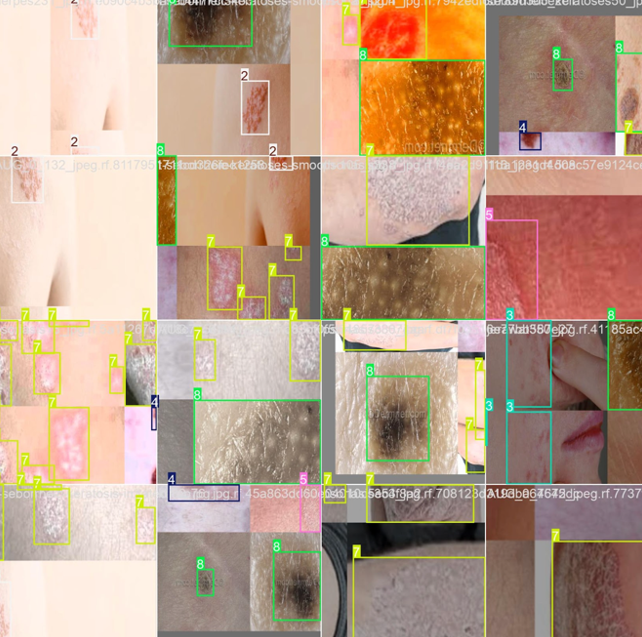
Recent advances in the field of deep learning have revealed significant potential for automating the detection of skin diseases by overcoming the limitations of traditional diagnostic methods in terms of speed and accessibility. This study presents a comparative analysis aimed at evaluating the performance of the state-of-the-art object detection models YOLOv8 and YOLOv11 in detecting ten different skin disease classes using a publicly available dataset. The dataset consists of a total of 2,486 images, divided into training, validation, and test subsets, and both models were trained under identical conditions for 100 epochs on a Tesla T4 GPU. To assess model effectiveness, performance metrics including precision, recall, F1-score, and mean Average Precision (mAP@0.5) were analyzed. The results indicate that, compared to YOLOv8, which achieved 84% precision and 91% recall, YOLOv11 attained 85% precision and 92% recall, demonstrating a limited improvement in both precision and recall metrics. Class-wise analyses revealed high detection performance for conditions such as Kurap (fungal infection), whereas relatively lower performance was observed for classes such as Bisul and Urticaria. Furthermore, YOLOv11 achieves this improvement while reducing the number of parameters by approximately 22%, thereby offering an advantage in terms of computational efficiency. These findings demonstrate that YOLOv11 provides a computationally efficient approach and indicate its potential use as a decision-support tool for dermatologists in resource-constrained environments.
Downloads
References
[1] Leelavathy, S., Jaichandran, R., Shobana, R., Vasudevan, S. S. P., & Prasad, N. (2020). Skin disease detection using computer vision and machine learning technique. European Journal of Molecular & Clinical Medicine, 7(4), 2999-3003.
[2] Talukdar, R., Dutta, S., & Das, S. (2023). Enhancing Skin Disease Diagnosis Through Convolutional Neural Networks and YOLO v8 Object Detection. 2023 7th International Conference on Electronics, Materials Engineering & Nano-Technology (IEMENTech), 1-6.
[3] Poornima, G., & Sakkari, D.S. (2022). Diagnosis of skin diseases based on deep learning and machine learning approach. International journal of health sciences.
[4] Talukdar, R., Dutta, S., & Das, S. (2023). Enhancing Skin Disease Diagnosis Through Convolutional Neural Networks and YOLO v8 Object Detection. 2023 7th International Conference on Electronics, Materials Engineering & Nano-Technology (IEMENTech), 1-6.
[5] Kumar, V.B., Kumar, S.S., & Saboo, V. (2016). Dermatological disease detection using image processing and machine learning. 2016 Third International Conference on Artificial Intelligence and Pattern Recognition (AIPR), 1-6.
[6] Anik, T.R., Talukder, P., Faruki, I., Rahman, I.S., & Hossain, E. (2023). Analysis of Automated Skin Disease Classification Exploiting Different Machine Learning Techniques. 2023 IEEE 13th Annual Computing and Communication Workshop and Conference (CCWC), 1145-1151.
[7] Junayed, M.S., Sakib, A.N., Anjum, N., Islam, M., & Jeny, A.A. (2020). EczemaNet: A Deep CNN-based Eczema Diseases Classification. 2020 IEEE 4th International Conference on Image Processing, Applications and Systems (IPAS), 174-179.
[8] Al-Saedi, D.K., & Savaş, S. (2022). Classification of Skin Cancer with Deep Transfer Learning Method. Computer Science.
[9] Mehra, A., Bhati, A., Kumar, A., & Malhotra, R. (2021). Skin Cancer Classification Through Transfer Learning Using ResNet-50.
[10] Nie, Y., Carratù, M., O’nils, M., Sommella, P., Ugwiri, M.A., & Lundgren, J. (2022). Skin Cancer Classification based on Cosine Cyclical Learning Rate with Deep Learning. 2022 IEEE International Instrumentation and Measurement Technology Conference (I2MTC), 1-6.
[11] Hosny, K.M., Kassem, M.A., & Foaud, M.M. (2018). Skin Cancer Classification using Deep Learning and Transfer Learning. 2018 9th Cairo International Biomedical Engineering Conference (CIBEC), 90-93.
[12] Upadhyay, M., Rawat, J., & Maji, S. (2021). Skin Cancer Image Classification Using Deep Neural Network Models. International Conference on Frontiers in Intelligent Computing: Theory and Applications.
[13] Rezvantalab, A., Safigholi, H., & Karimijeshni, S. (2018). Dermatologist Level Dermoscopy Skin Cancer Classification Using Different Deep Learning Convolutional Neural Networks Algorithms. ArXiv, abs/1810.10348.
[14] Roboflow, 2024. https://universe.roboflow.com/capstone-7x5vm/skin-disease-7u8pj
[15] Redmon, J., Divvala, S.K., Girshick, R.B., & Farhadi, A. (2015). You Only Look Once: Unified, Real-Time Object Detection. 2016 IEEE Conference on Computer Vision and Pattern Recognition (CVPR), 779-788.
[16] Kivrak, O., & Gürbüz, M.Z. (2022). YOLOv3, YOLOv4 ve YOLOv5 algoritmalarının Performans Karşılaştırması: Kümes Hayvan Tanıma İçin Bir Vaka Çalışması. European Journal of Science and Technology.
[17] Hussain, M. (2023). YOLO-v1 to YOLO-v8, the Rise of YOLO and Its Complementary Nature toward Digital Manufacturing and Industrial Defect Detection. Machines.
[18] Thakur, D., Pal, P., Jadhav, A., Kable, N., V, B., & Deshpande, S. (2023). YOLOv8- Based Helmet and Vest Detection System for Safety Assessment. 2023 International Conference on Network, Multimedia and Information Technology (NMITCON), 1-10.
[19] Terven, J.R., Esparza, D.M., & Romero-González, J. (2023). A Comprehensive Review of YOLO Architectures in Computer Vision: From YOLOv1 to YOLOv8 and YOLO-NAS. Mach. Learn. Knowl. Extr., 5, 1680-1716.
[20] Padilla, R., Netto, S. L., & Da Silva, E. A. (2020, July). A survey on performance metrics for object-detection algorithms. In 2020 international conference on systems, signals and image processing (IWSSIP) (pp. 237-242). IEEE.
[21] Parlak, I. E., & Emel, E. (2023). Deep learning-based detection of aluminum casting defects and their types. Engineering Applications of Artificial Intelligence, 118, 105636.
[22] Derg, B., Bilginer, O., Tunga, B., & Demirer, R.M. (2021). Classification of skin lesions using convolutional neural networks.
[23] Zhang, Y., Mao, Y., Lu, X., Zou, X., Huang, H., Li, X., ... & Zhang, H. (2024). From single to universal: tiny lesion detection in medical imaging. Artificial Intelligence Review, 57(8), 192.
[24] Hsiao, Y. P., Chiu, C. W., Lu, C. W., Nguyen, H. T., Tseng, Y. S., Hsieh, S. C., & Wang, H. C. (2021). Identification of skin lesions by using single-step multiframe detector. Journal of Clinical Medicine, 10(1), 144.
[25] Ding, H., Zhang, E., Fang, F., Liu, X., Zheng, H., Yang, H., ... & Lin, T. (2022). Automatic identification of benign pigmented skin lesions from clinical images using deep convolutional neural network. BMC biotechnology, 22(1), 28.
[26] Elshahawy, M., Elnemr, A., Oproescu, M., Schiopu, A. G., Elgarayhi, A., Elmogy, M. M., & Sallah, M. (2023). Early melanoma detection based on a hybrid YOLOv5 and ResNet technique. Diagnostics, 13(17), 2804.
[27] Datta, D., Prakash, H., & Singh, P. (2023, June). Skin cancer detection with edge devices using YOLOv7 deep CNN. In International conference on data analytics & management (pp. 55-63). Singapore: Springer Nature Singapore.
[28] AlSadhan, N. A., Alamri, S. A., Ben Ismail, M. M., & Bchir, O. (2024). Skin cancer recognition using unified deep convolutional neural networks. Cancers, 16(7), 1246.
[29] Gül, S., Cetinel, G., Aydin, B. M., Akgün, D., & Öztaş Kara, R. (2025). YOLOSAMIC: A Hybrid Approach to Skin Cancer Segmentation with the Segment Anything Model and YOLOv8. Diagnostics, 15(4), 479.
[30] Dalawai, N. A., Prathamraj, P. B., Dayananda, B. S., Joythi, A. P., & Suresh, R. (2024). Real-Time Skin Disease Detection and Classification Using YOLOv8 Object Detection for Healthcare Diagnosis. INTERNATIONAL JOURNAL OF MULTIDISCIPLINARY RESEARCH AND ANALYSIS, 7(12).
[31] Ma, J., Wu, F., Zhu, J., Xu, D., & Kong, D. (2017). A pre-trained convolutional neural network based method for thyroid nodule diagnosis. Ultrasonics, 73, 221-230.
[32] Li, Y., & Shen, L. (2018). Skin lesion analysis towards melanoma detection using deep learning network. Sensors, 18(2), 556.
[33] Aishwarya, N., Prabhakaran, K. M., Debebe, F. T., Reddy, M. S. S. A., & Pranavee, P. (2023). Skin cancer diagnosis with YOLO deep neural network. Procedia Computer Science, 220, 651-658.
[34] Amin, J., Azhar, M., Arshad, H., Zafar, A., & Kim, S. H. (2025). Skin-lesion segmentation using boundary-aware segmentation network and classification based on a mixture of convolutional and transformer neural networks. Frontiers in Medicine, 12, 1524146.
[35] Zhang, Y., Xie, Y., Wang, H., Avery, J. C., Hull, M. L., & Carneiro, G. (2025, February). A Novel Perspective for Multi-modal Multi-label Skin Lesion Classification. In 2025 IEEE/CVF Winter Conference on Applications of Computer Vision (WACV) (pp. 3549-3558). IEEE.
[36] He, X., Wang, S., Shi, S., Tang, Z., Wang, Y., Zhao, Z., ... & Chu, X. (2019, December). Computer-aided clinical skin disease diagnosis using cnn and object detection models. In 2019 IEEE international conference on big data (Big Data) (pp. 4839-4844). IEEE.
[37] Yaseliani, M., Maghsoodi, A. I., Hassannayebi, E., & Aickelin, U. (2024). Diagnostic clinical decision support based on deep learning and knowledge-based systems for psoriasis: From diagnosis to treatment options. Computers & Industrial Engineering, 187, 109754.
[38] Diptho, R. A., & Basak, S. (2025). Enhancing Dermatological Diagnosis Through Medical Image Analysis: How Effective Is YOLO11 Compared to Leading CNN Models?. NDT, 3(2), 11.
[39] Aishwarya, N., Kannaa, G. Y., & Seemakurthy, K. (2025). YOLOSkin: A fusion framework for improved skin cancer diagnosis using YOLO detectors on Nvidia Jetson Nano. Biomedical Signal Processing and Control, 100, 107093.
[40] Malik, S. G., Jamil, S. S., Aziz, A., Ullah, S., Ullah, I., & Abohashrh, M. (2024). High-precision skin disease diagnosis through deep learning on dermoscopic images. Bioengineering, 11(9), 867.
Downloads
Published
Issue
Section
License
Copyright (c) 2025 International Journal of Applied Methods in Electronics and Computers

This work is licensed under a Creative Commons Attribution-ShareAlike 4.0 International License.