Classification of Orthopedic Diseases Using Biomechanical Properties with Machine Learning Methods
DOI:
https://doi.org/10.58190/ijamec.2026.163Keywords:
Biomechanical Features, K-fold Cross Validation, Machine Learning, SMOTEAbstract
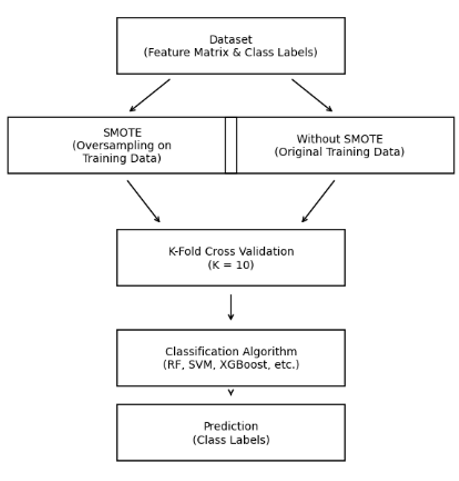
Orthopedic diseases significantly affect the musculoskeletal system, reducing patients’ functional capacity and quality of life. Accurate and early classification of such conditions is therefore critical for effective clinical decision-making. This study proposes a machine learning-based framework for orthopedic disease classification using biomechanical features, with a particular emphasis on handling class imbalance. A set of classification algorithms, including Random Forest, Support Vector Machine, Naive Bayes, Logistic Regression, XGBoost, LightGBM, and a Soft Voting Ensemble (XGBoost + LightGBM), were evaluated on a dataset of 310 patients using 10-fold cross-validation. The impact of the Synthetic Minority Over-sampling Technique (SMOTE) was systematically analyzed by comparing model performance with and without its application. Evaluation metrics included Accuracy, Precision, Recall, F1-score, and macro-average ROC-AUC. Results indicate that addressing class imbalance significantly improves model performance, particularly in terms of ROC-AUC. Among the tested methods, Logistic Regression demonstrated the most stable and competitive results. The best performance was achieved by Logistic Regression with SMOTE, yielding 87% accuracy and a macro-average ROC-AUC of 0.96. These findings highlight the importance of imbalance-aware modeling strategies in orthopedic disease classification.
Downloads
References
[1] A. M. Elshewey and A. M. Osman, “Orthopedic disease classification based on breadth-first search algorithm,” Scientific Reports, vol. 14, no. 1, Art. no. 23368, 2024.
[2] Y. Zhang, X. Liu, and H. Wang, “Spinal disease classification using SMOTE-RFE-XGBoost model,” PeerJ Computer Science, vol. 9, e1280, 2023.
[3] L. Frizziero et al., “New methodology for diagnosis of orthopedic diseases through additive manufacturing models,” Symmetry, vol. 11, no. 4, Art. no. 542, 2019, doi: 10.3390/sym11040542.
[4] S. Kıvrak, M. A. Aydın, and H. Polat, “Evaluation of machine learning models with SMOTE for imbalanced medical datasets,” Diagnostics, vol. 14, no. 23, Art. no. 2634, 2024.
[5] Z. Yang et al., “A hybrid machine learning approach using SMOTE and ensemble methods for healthcare prediction,” Scientific Reports, vol. 15, Art. no. 92722, 2025.
[6] Y. Gyasi-Agyei, “Comparative analysis of machine learning algorithms for medical diagnosis,” Results in Engineering, vol. 21, Art. no. 101234, 2025.
[7] S. Rezapour, M. H. Mahoor, and R. L. Figueroa, “Machine learning-based gait analysis for orthopedic disorder prediction using SMOTE,” arXiv preprint arXiv:2309.15990, 2023.
[8] H. B. Kibria and A. Matin, “The severity prediction of binary and multi-class cardiovascular disease—a machine learning-based fusion approach,” Comput. Biol. Chem., vol. 98, Art. no. 107672, 2022, doi: 10.1016/j.compbiolchem.2022.107672.
[9] S. Li and X. Zhang, “Research on orthopedic auxiliary classification and prediction model based on XGBoost algorithm,” Neural Comput. Appl., vol. 32, pp. 1971–1979, 2020, doi: 10.1007/s00521-019-04378-4.
[10] C. J. Ling et al., “Machine learning-based segmentation of images to diagnose orthopedic diseases and to guide orthopedic surgeries,” Soft Comput., 2023, doi: 10.1007/s00500-023-08503-3.
[11] N. Rubaiyat et al., “Classification and prediction of orthopedic disease based on lumbar and pelvic state of patients,” in Proc. IEEE Int. Conf. Electr., Comput. Commun. Technol. (ICECCT), pp. 1–4, 2019, doi: 10.1109/ICECCT.2019.8869540.
[12] N. Jahan et al., “Classification of orthopedic patients using supervised machine learning techniques,” in Intelligent Computing and Optimization, Springer, pp. 659–669, 2021, doi: 10.1007/978-3-030-68154-8_61.
[13] K. Hasan et al., “A machine learning approach on classifying orthopedic patients based on their biomechanical features,” in Proc. 7th Int. Conf. Informatics, Electron. Vis. (ICIEV) and 2nd Int. Conf. Imaging, Vis. Pattern Recognit. (icIVPR), pp. 289–294, 2018, doi: 10.1109/ICIEV.2018.8641004.
[14] Q. Chen, Y. Zhang, M. Zhang, Z. Li, and J. Liu, “Application of machine learning algorithms to predict acute kidney injury in elderly orthopedic postoperative patients,” Clin. Interv. Aging, pp. 317–330, 2023.
[15] D. H. Mantzaris, G. C. Anastassopoulos, and D. K. Lymberopoulos, “Medical disease prediction using artificial neural networks,” in Proc. IEEE Int. Conf. Bioinformatics and Bioengineering, pp. 1–6, 2008.
[16] S. W. Chung et al., “Automated detection and classification of the proximal humerus fracture by using deep learning algorithm,” Acta Orthop., vol. 89, no. 4, pp. 468–473, 2018, doi: 10.1080/17453674.2018.1453714.
[17] J. Olczak et al., “Ankle fracture classification using deep learning: Automating detailed AO/OTA 2018 malleolar fracture identification,” Acta Orthop., vol. 92, no. 1, pp. 102–108, 2020, doi: 10.1080/17453674.2020.1837420.
[18] L. Cao, R. Li, D. Zhou, M. Zhao, and W. Huang, “Deep learning-based diagnosis and classification of femoral head necrosis,” in Proc. 5th Int. Conf. Artif. Intell. Ind. Technol. Appl. (AIITA), pp. 1225–1228, 2025.
[19] A. M. Elshewey and A. M. Osman, “Orthopedic disease classification based on breadth-first search algorithm,” Sci. Rep., vol. 14, no. 1, Art. no. 23368, 2024.
[20] UCI Machine Learning Repository, “Biomechanical features of orthopedic patients,” 2023. [Online]. Available: Kaggle dataset.
[21] D. Elreedy and A. F. Atiya, “A comprehensive analysis of synthetic minority oversampling technique (SMOTE) for handling class imbalance,” Inf. Sci., vol. 505, pp. 32–64, 2019.
[22] P. Dutta, S. Paul, and M. Majumder, “An efficient SMOTE based machine learning classification for prediction and detection of PCOS,” 2021.
[23] Abacı, İ., & Yıldız, K. SMOTE vs. KNNOR: An evaluation of oversampling techniques in machine learning. Gümüşhane Üniversitesi Fen Bilimleri Dergisi, 13(3), 767-779, 2023.
[24] Z. Sun et al., “An improved random forest based on the classification accuracy and correlation measurement of decision trees,” Expert Syst. Appl., vol. 237, Art. no. 121549, 2024.
[25] K. J. Archer and R. V. Kimes, “Empirical characterization of random forest variable importance measures,” Comput. Stat. Data Anal., vol. 52, no. 4, pp. 2249–2260, 2008, doi: 10.1016/j.csda.2007.08.015.
[26] L. Breiman, “Random forests,” Mach. Learn., vol. 45, pp. 5–32, 2001, doi: 10.1023/A:1010933404324.
[27] Y. Arora and S. K. Gupta, “Brain tumor classification using weighted least square twin support vector machine with fuzzy hyperplane,” Eng. Appl. Artif. Intell., vol. 138, Art. no. 109450, 2024.
[28] S. Huang et al., “Applications of support vector machine learning in cancer genomics,” Cancer Genomics Proteomics, vol. 15, no. 1, pp. 41–51, 2018, doi: 10.21873/cgp.20063.
[29] A. Patle and D. S. Chouhan, “SVM kernel functions for classification,” in Proc. Int. Conf. Adv. Technol. Eng. (ICATE), pp. 1–9, 2013, doi: 10.1109/ICAdTE.2013.6524737.
[30] O. N. Manjrekar and M. P. Dudukovic, “Identification of flow regime in a bubble column reactor with a combination of optical probe data and machine learning technique,” Chem. Eng. Sci.: X, vol. 2, Art. no. 100023, 2019, doi: 10.1016/j.cesx.2019.100023.
[31] A. G. Abdulameer, A. S. Hammood, F. M. Abdulwahed, and A. A. Ayyash, “Naïve Bayes algorithm for timely fault diagnosis in helical gear transmissions using vibration signal analysis,” Int. J. Interact. Des. Manuf., vol. 19, no. 5, pp. 3695–3706, 2025.
[32] Ö. Tonkal and H. Polat, “Traffic classification and comparative analysis with machine learning algorithms in software defined networks,” Gazi Univ. J. Sci. C: Des. Technol., vol. 9, no. 1, pp. 71–83, 2021, doi: 10.29109/gujsc.869418.
[33] B. Cömert, “Alın bölgesinden alınan elektrookülogram (EOG) işaretleri için ölçüm devresi tasarımı ve sınıflandırılması,” M.S. thesis, Balıkesir Univ., Inst. Sci., Balıkesir, Türkiye, 2016.
[34] H. Li et al., “Prediction of urban forest aboveground carbon using machine learning based on Landsat 8 and Sentinel-2,” Remote Sens., vol. 15, no. 1, Art. no. 284, 2023, doi: 10.3390/rs15010284.
[35] A. Tasic et al., “Towards sustainable societies: Convolutional neural networks optimized by modified crayfish optimization algorithm aided by AdaBoost and XGBoost for waste classification tasks,” Appl. Soft Comput., vol. 175, Art. no. 113086, 2025.
[36] S. Kakkar et al., “Enhancing energy efficiency and classification modeling through a combined approach of LightGBM and stratified k-fold cross-validation,” Electr. Power Compon. Syst., pp. 1–19, 2024.
[37] S. Dörterler, “Hybridization of k-means and meta-heuristics algorithms for heart disease diagnosis,” New Trends Eng. Appl. Nat. Sci., p. 55, 2022.
[38] Nithya, R., Kokilavani, T., & Beena, T. L. A. Balancing cerebrovascular disease data with integrated ensemble learning and SVM-SMOTE. Network Modeling Analysis in Health Informatics and Bioinformatics, 13(1), 12, 2024.
[39] Karamti, H., Alharthi, R., Anizi, A. A., Alhebshi, R. M., Eshmawi, A. A., Alsubai, S., & Umer, M. Improving prediction of cervical cancer using KNN imputed SMOTE features and multi-model ensemble learning approach. Cancers, 15(17), 4412, 2023.
Downloads
Published
Issue
Section
License
Copyright (c) 2026 International Journal of Applied Methods in Electronics and Computers

This work is licensed under a Creative Commons Attribution-ShareAlike 4.0 International License.