Comparative Evaluation of Machine Learning Algorithms for Raisin Variety Classification Based on Morphological Features
DOI:
https://doi.org/10.58190/ijamec.2026.173Keywords:
Raisin Classification, k-Nearest Neighbors (k-NN), Multilayer Perceptron (MLP), Support Vector Machines (SVM), WEKAAbstract
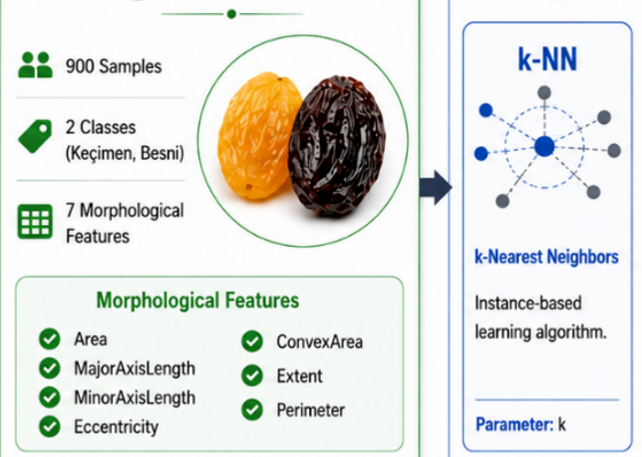
Machine learning algorithms enable the rapid, accurate, and automated classification of agricultural products. Compared to human visual assessment, these algorithms provide more consistent and highly accurate determination of product characteristics such as variety and quality. In this study, machine learning algorithms were employed to classify Keçimen and Besni raisin varieties cultivated in Turkey. The Raisin dataset obtained from the UCI Machine Learning Repository was used as the data source. For the classification task, k-Nearest Neighbors (k-NN), Multilayer Perceptron (MLP), and Support Vector Machines (SVM) algorithms were utilized. The classification process was carried out using the WEKA software. Initially, the dataset was divided into 80% training and 20% testing subsets, and classification was performed accordingly. Subsequently, the classification process was repeated using the 10-fold cross-validation method. The obtained performance results were evaluated comparatively among the applied algorithms. The MLP algorithm achieved the highest performance, with an accuracy of 92.78% and an AUC of 0.968 under the 80% training–20% testing scheme. Under 10-fold cross-validation, MLP also produced the highest accuracy and AUC values of 87.22% and 0.928, respectively. Although the k-NN and SVM algorithms also produced satisfactory results, they did not reach the performance level of MLP. The findings demonstrate that the evaluated machine learning algorithms can provide effective classification performance for the two raisin varieties under the experimental conditions considered in this study.
Downloads
References
[1] A. Krizhevsky, I. Sutskever, and G. E. Hinton, “ImageNet classification with deep convolutional neural networks,” Advances in Neural Information Processing Systems, vol. 25, pp. 1097–1105, 2012.
[2] R. C. Gonzalez and R. E. Woods, Digital Image Processing, 4th ed. New York, NY, USA: Pearson, 2018.
[3] M. E. Sönmez, K. Sabancı, and N. Aydın, “Classification of Wheat Rootstock and Their Hybrids According to Color Features by Machine Learning Algorithms,” International Journal of Applied Mathematics Electronics and Computers, vol. 10, no. 2, pp. 39–48, Jun. 2022, doi: 10.18100/ijamec.1098276.
[4] H. Bulduk and K. Sabancı, “A Hybrid Model Approach Based on Swin Transformer and EfficientNetV2 for Maize Variety Classification,” International Journal of Applied Methods in Electronics and Computers, vol. 13, no. 3, pp. 84–92, 2025, doi: 10.58190/ijamec.2025.132.
[5] H. Bulduk and K. Sabancı, “Performance Comparison of SVM Kernel Functions for Date Fruit Classification,” International Journal of Applied Methods in Electronics and Computers, vol. 13, no. 3, pp. 58–64, 2025, doi: 10.58190/ijamec.2025.129.
[6] N. Karimi, A. Arabhosseini, M. H. Kianmehr, and J. Khazaei, “Modelling of raisin berries by some physical and statistical characteristics,” International Agrophysics, vol. 25, no. 2, pp. 141–147, 2011.
[7] A. Semerci, T. Kızıltuğ, A. Çelik, and M. Kiracı, “Türkiye bağcılığının genel durumu,” Mustafa Kemal Üniversitesi Ziraat Fakültesi Dergisi, vol. 20, no. 2, pp. 42–51, 2015.
[8] İ. Çınar, M. Koklu, and Ş. Taşdemir, “Classification of raisin grains using machine vision and artificial intelligence methods,” Gazi Journal of Engineering Sciences, vol. 6, no. 3, pp. 200–209, 2020.
[9] M. Khojastehnazhand and H. Ramezani, “Machine vision system for classification of bulk raisins using texture features”, Journal of Food Engineering, vol. 271, p. 109864, 2020.
[10] S. Wang, K. Liu, X. Yu, D. Wu, and Y. He, “Application of hybrid image features for fast and non-invasive classification of raisin”, Journal of Food Engineering, vol. 109, no. 3, pp. 531–537, 2012.
[11] X. Yu, K. Liu, D. Wu, and Y. He, “Raisin Quality Classification Using Least Squares Support Vector Machine (LSSVM) Based on Combined Color and Texture Features,” Food and Bioprocess Technology, vol. 5, pp. 1552–1563, 2012, doi: 10.1007/s11947-011-0531-9.
[12] A. Bisri and M. Man, “Machine Learning Algorithms Based on Sampling Techniques for Raisin Grains Classification”, JOIV: International Journal on Informatics Visualization, vol. 7, no. 1, pp. 7–14, 2023.
[13] O. Şahin, “Raisin Grain Classification Using Machine Learning Models”, in Proc. 2023 IEEE International Students’ Conference on Electrical, Electronics and Computer Science (SCEECS), Bhopal, India, 2023, pp. 1–6, doi: 10.1109/SCEECS57921.2023.10063039.
[14] Y. Ünal, H. Kaplan, Y. Bektaş, and M. B. Çağlar, “Classification of raisin grains variety using some machine learning methods”, New Trends in Computer Sciences, vol. 1, no. 1, pp. 62–69, 2023, doi: 10.3846/ntcs.2023.18015.
[15] J. Guo, C. Chen, C. Chen, E. Zuo, B. Dong, X. Lv, and W. Yang, “Near-infrared spectroscopy combined with pattern recognition algorithms to quickly classify raisins”, Scientific Reports, vol. 12, no. 1, p. 7928, 2022.
[16] X. Zhou, “Raisin classification based on XGBoost, SVM, MLP and logistic regression,” in Second International Conference on Statistics, Applied Mathematics, and Computing Science (CSAMCS 2022), SPIE, vol. 12597, pp. 150–157, 2023. doi: 10.1117/12.2672686.
[17] M. Dirik, “Improving Raisin Grains Classification with a Hybrid PSO-NN Approach,” in Proc. 1st International Conference on Contemporary Academic Research (ICCAR 2023), pp. 17–19, 2023.
[18] Y. Ramdhani, D. F. Apra, and D. P. Alamsyah, “Feature selection optimization based on genetic algorithm for support vector classification varieties of raisin”, Indonesian Journal of Electrical Engineering and Computer Science, vol. 30, no. 1, p. 192, 2023.
[19] W. U. Dewi, K. Nisa, and M. Usman, “Implementation of decision tree and support vector machine on raisin seed classification”, AKSIOMA: Jurnal Program Studi Pendidikan Matematika, vol. 12, no. 1, pp. 1309–1321, 2023.
[20] N. Karimi, R. R. Kondrood, and T. Alizadeh, “An intelligent system for quality measurement of Golden Bleached raisins using two comparative machine learning algorithms”, Measurement, vol. 107, pp. 68–76, 2017.
[21] E. K. Yılmaz, T. Oğuz, and K. Adem, “A CNN-Based Hybrid Approach to Classification of Raisin Grains,” in Proc. International Conference on Frontiers in Academic Research, vol. 1, pp. 460–467, 2023.
[22] S. Kılıçarslan, “Kuru Üzüm Tanelerinin Sınıflandırılması İçin Hibrit Bir Yaklaşım,” Mühendislik Bilimleri ve Araştırmaları Dergisi, vol. 4, no. 1, pp. 62–71, 2022, doi: 10.46387/bjesr.1084590.
[23] M. N. Raihen and S. Akter, “Prediction modeling using deep learning for the classification of raisin varieties-type dried fruits”, International Journal of Mathematics and Computer in Engineering, vol. 2, no. 1, pp. 1–12, 2023.
[24] T. M. Mohamed and S. N. Abdulkader, “A novel deep learning model for raisin grains classification,” Journal of Theoretical and Applied Information Technology, vol. 101, no. 21, pp. 7052–7063, Nov. 2023.
[25] İ. Çınar, M. Koklu, and Ş. Taşdemir, “Raisin,” UCI Machine Learning Repository, 2020, doi: 10.24432/C5660T.
[26] E. Frank, M. A. Hall, and I. H. Witten, “The WEKA Workbench,” online appendix for Data Mining: Practical Machine Learning Tools and Techniques, 4th ed. Burlington, MA, USA: Morgan Kaufmann, 2016.
[27] T. Cover and P. Hart, “Nearest neighbor pattern classification,” IEEE Transactions on Information Theory, vol. 13, pp. 21–27, 1967, doi: 10.1109/TIT.1967.1053964.
[28] S. Haykin, Neural Networks: A Comprehensive Foundation, 2nd ed. Englewood Cliffs, NJ, USA: Prentice Hall, 1999.
[29] C. Cortes and V. Vapnik, “Support-vector networks,” Machine Learning, vol. 20, pp. 273–297, 1995, doi: 10.1007/BF00994018.
Downloads
Published
Issue
Section
License
Copyright (c) 2026 International Journal of Applied Methods in Electronics and Computers

This work is licensed under a Creative Commons Attribution-ShareAlike 4.0 International License.