Indabot: A Simulation-Based Study of Low-Cost, ArUco Marker-Based Autonomous Navigation for Indoor Plant Phenotyping
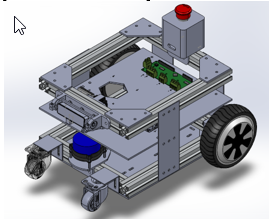
Indabot: A Simulation-Based Study of Low-Cost, ArUco Marker-Based Autonomous Navigation for Indoor Plant Phenotyping
Official scientific asset for International Journal of Applied Methods in Electronics and Computers
Abstract
Autonomous robotic platforms are of critical importance for high-throughput plant phenotyping in controlled agricultural environments. The vast majority of existing systems are designed for open-field deployment and rely on satellite-based navigation, which is not suitable for enclosed greenhouse settings. This study presents the design, simulation-based performance analysis of Indabot, an autonomous mobile robot developed for wheat phenotyping in indoor environments. Each wheat sample is uniquely tagged with an ArUco marker, enabling drift-free, plant-level localization without the need for any GPS infrastructure. A rotation-based random search navigation scenario was designed in the Webots R2023b environment, in which the OpenCV ArUco module was combined with discrete-time PID controllers and lidar distance feedback. The system achieved a 100% target detection rate across 13 independent simulation runs, with a mean mission completion time of 282.4 ± 6.2 s (n=13, CV=2.2%), a marker centering error of 3.06 ± 0.51 pixels, and an average approach time per target of 19.4 ± 0.4 s. The findings demonstrate that the Indabot platform, operating under ArUco-based guidance, offers a consistent, scalable, and low-cost autonomous phenotyping alternative for indoor agricultural environments. All performance metrics reported in this study were obtained exclusively within the Webots simulation environment; no physical validation of the platform has yet been conducted, and this constitutes a key limitation of the present work.
Author Affiliations
- Fikret UYSAL— Karamanoglu Mehmetbey University, Department of Electrical and Electronics Engineering, Karaman, Türkiyefingerprinthttps://orcid.org/0000-0002-1432-3498
- Kadir Sabancı— Karamanoglu Mehmetbey University, Department of Electrical and Electronics Engineering, Karaman, Türkiyefingerprinthttps://orcid.org/0000-0003-0238-9606
References (18)
- 1
B. Shiferaw et al., “Crops that feed the world 10. Past successes and future challenges to the role played by wheat in global food security,” Food Security, vol. 5, pp. 291–317, 2013, doi: 10.1007/s12571-013-0263-y.
- 2
J. L. Araus and J. E. Cairns, “Field high-throughput phenotyping: The new crop breeding frontier,” Trends in Plant Science, vol. 19, no. 1, pp. 52–61, 2014, doi: 10.1016/j.tplants.2013.09.008.
- 3
A. Atefi et al., “Robotic technologies for high-throughput plant phenotyping: Contemporary reviews and future perspectives,” Frontiers in Plant Science, vol. 12, p. 611940, 2021, doi: 10.3389/fpls.2021.611940.
- 4
R. Xu and C. Li, "A Review of High-Throughput Field Phenotyping Systems: Focusing on Ground Robots," Plant Phenomics, vol. 2022, p. 9760269, 2022. doi: 10.34133/2022/9760269
- 5
R. R. Shamshiri et al., “Advances in greenhouse automation and controlled environment agriculture: A transition to plant factories and urban agriculture,” International Journal of Agricultural and Biological Engineering, vol. 11, no. 1, pp. 1–22, 2018, doi: 10.25165/j.ijabe.20181101.3210.
- 6
C. Zhao et al., “Crop phenomics: Current status and perspectives,” Frontiers in Plant Science, vol. 10, p. 714, 2019, doi: 10.3389/fpls.2019.00714.
- 7
A. Ruckelshausen, P. Biber, M. Dorna, H. Gremmes, R. Klose, A. Linz, F. Rahe, R. Resch, M. Thiel, D. Trautz, and U. Weiss, "BoniRob – An autonomous field robot platform for individual plant phenotyping," in Precision Agriculture '09: Papers Presented at the 7th European Conference on Precision Agriculture, Wageningen Academic Publishers, 2009, pp. 841–847, doi: 10.1163/9789086866649_101
- 8
L. Grimstad and P. J. From, “Thorvald II – A modular and re-configurable agricultural robot,” IFAC-PapersOnLine, vol. 50, no. 1, pp. 4588–4593, 2017, doi: 10.1016/j.ifacol.2017.08.1005.
- 9
M. Yang, Z. Li, J. Cui et al., "PhenoRob-F: An autonomous ground-based robot for high-throughput phenotyping of field crops," Plant Phenomics, vol. 7, p. 100085, 2025, doi: 10.1016/j.plaphe.2025.100085
- 10
S. Garrido-Jurado, R. Muñoz-Salinas, F. J. Madrid-Cuevas, and M. J. Marín-Jiménez, “Automatic generation and detection of highly reliable fiducial markers under occlusion,” Pattern Recognition, vol. 47, no. 6, pp. 2280–2292, 2014, doi: 10.1016/j.patcog.2014.01.005.
- 11
M. Kalaitzakis et al., “Fiducial markers for pose estimation: Overview, applications and experimental comparison of the ARTag, AprilTag, ArUco and STag markers,” Journal of Intelligent & Robotic Systems, vol. 101, p. 71, 2021, doi: 10.1007/s10846-020-01307-9.
- 12
R. Adámek, M. Brablc, P. Vávra, B. Dobossy, M. Formánek, and F. Radil, "Analytical Models for Pose Estimate Variance of Planar Fiducial Markers for Mobile Robot Localisation," Sensors, vol. 23, no. 12, p. 5746, 2023. doi: 10.3390/s23125746
- 13
P. Oščádal, D. Heczko, A. Vysocký, J. Mlotek, P. Novák, I. Virgala, M. Sukop, and Z. Bobovský, "Improved Pose Estimation of ArUco Tags Using a Novel 3D Placement Strategy," Sensors, vol. 20, no. 17, p. 4825, 2020, doi: 10.3390/s20174825
- 14
S. Hinderer, M. Scheffler, and B. Yang, "Investigation of ArUco Marker Placement for Planar Indoor Localization," in Proc. IEEE 22nd International Conference on Advanced Robotics (ICAR), 2025, doi: 10.1109/ICAR65334.2025.11338671.
- 15
L. He, Y. Sun, L. Chen, Q. Feng, Y. Li, J. Lin, Y. Qiao, and C. Zhao, "Advance on Agricultural Robot Hand–Eye Coordination for Agronomic Task: A Review," Engineering, vol. 51, no. 8, pp. 263–279, 2025. doi: 10.1016/j.eng.2025.01.022
- 16
A. Farley, J. Wang, and J. A. Marshall, “How to pick a mobile robot simulator: A quantitative comparison of CoppeliaSim, Gazebo, MORSE and Webots with a focus on accuracy of motion,” Simulation Modelling Practice and Theory, vol. 120, p. 102629, 2022, doi: 10.1016/j.simpat.2022.102629.
- 17
O. Michel, “Cyberbotics Ltd. Webots™: Professional mobile robot simulation,” International Journal of Advanced Robotic Systems, vol. 1, no. 1, pp. 39–42, 2004, doi: 10.5772/5618.
- 18
F. Uysal, "Indabot: Dönüş Tabanlı Rasgele Arama Navigasyon Senaryosu Simülasyonu," Accessed: [2026.05.08]. [Online]. Available: https://youtu.be/ys5OUzBz08M.