Domain-Specific Fine-Tuning of LLMs for Elevator Emergency Response Systems
Domain-Specific Fine-Tuning of LLMs for Elevator Emergency Response Systems
Official scientific asset for International Journal of Applied Methods in Electronics and Computers
Abstract
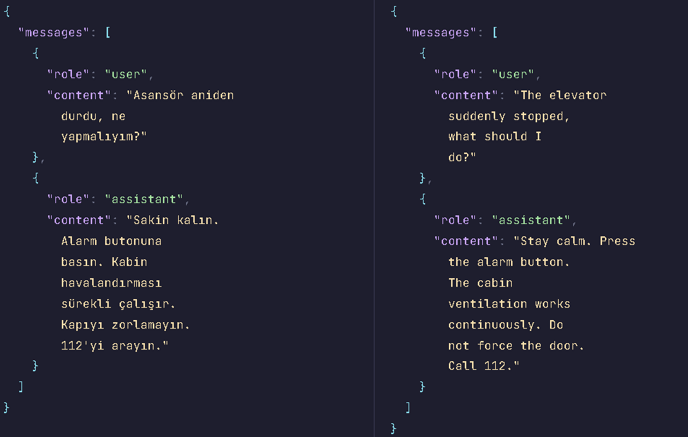
Large Language Models (LLMs) have demonstrated remarkable capabilities in natural language understanding and generation. However, their application in safety-critical domains such as elevator emergency response requires domain-specific knowledge and reliable performance, particularly when deployed as offline edge AI systems with constrained computational resources. This study presents fine-tuning of the Gemma-2-9B-Instruct model using Quantized Low-Rank Adaptation (QLoRA) for Turkish elevator emergency scenarios, targeting deployment on embedded touchscreen control panels inside elevator cabins. Unlike cloud-based systems leveraging internet connectivity for retrieval, our edge deployment operates entirely offline, making fine-tuning essential for encoding domain knowledge directly into model parameters. We developed a specialized Turkish dataset containing 1,155 question-answer pairs covering diverse emergency situations. Our evaluation demonstrates significant improvements: ROUGE-1 scores increased from 0.259 to 0.317 (22.49%), BLEU improved by 218.11%, and hallucination rates reduced from 54% to 22% while achieving 49% faster inference. The resulting 4.8GB quantized model runs entirely on embedded hardware without network dependencies, providing immediate, reliable emergency guidance. These results validate parameter-efficient fine-tuning for safety-critical edge AI applications.
Author Affiliations
- Busra Onal— Butkon Elevator Industry Trade Inc., Research and Development Center, Konya, Türkiyefingerprinthttps://orcid.org/0009-0003-0438-3440
- Muhammet Fatih Aslan— Department of Artificial Intelligence and Machine Learning, Faculty of Computer and Information Sciences, Konya Technical University, Konya 42000, Türkiyefingerprinthttps://orcid.org/0000-0001-7549-0137
- Akif Durdu— Department of Electrical-Electronic Engineering, Konya Technical Universityfingerprinthttps://orcid.org/0000-0002-5611-2322
References (23)
- 1
A. Vaswani et al., "Attention is all you need," Advances in neural information processing systems, vol. 30, 2017.
- 2
T. Brown et al., "Language models are few-shot learners," Advances in neural information processing systems, vol. 33, pp. 1877-1901, 2020.
- 3
L. Ouyang et al., "Training language models to follow instructions with human feedback," Advances in neural information processing systems, vol. 35, pp. 27730-27744, 2022.
- 4
H. Touvron et al., "Llama: Open and efficient foundation language models," arXiv preprint arXiv:2302.13971, 2023.
- 5
G. Team et al., "Gemma 2: Improving open language models at a practical size," arXiv preprint arXiv:2408.00118, 2024.
- 6
Z. Ji et al., "Survey of hallucination in natural language generation," ACM computing surveys, vol. 55, no. 12, pp. 1-38, 2023.
- 7
A. Conneau et al., "Unsupervised cross-lingual representation learning at scale," in Proceedings of the 58th annual meeting of the association for computational linguistics, 2020, pp. 8440-8451.
- 8
P. Lewis et al., "Retrieval-augmented generation for knowledge-intensive nlp tasks," Advances in neural information processing systems, vol. 33, pp. 9459-9474, 2020.
- 9
E. J. Hu et al., "Lora: Low-rank adaptation of large language models," ICLR, vol. 1, no. 2, p. 3, 2022.
- 10
T. Dettmers, A. Pagnoni, A. Holtzman, and L. Zettlemoyer, "Qlora: Efficient finetuning of quantized llms," Advances in neural information processing systems, vol. 36, pp. 10088-10115, 2023.
- 11
J. Lee et al., "BioBERT: a pre-trained biomedical language representation model for biomedical text mining," Bioinformatics, vol. 36, no. 4, pp. 1234-1240, 2020.
- 12
I. Chalkidis, M. Fergadiotis, P. Malakasiotis, N. Aletras, and I. Androutsopoulos, "LEGAL-BERT: The muppets straight out of law school," arXiv preprint arXiv:2010.02559, 2020.
- 13
I. Beltagy, K. Lo, and A. Cohan, "SciBERT: A pretrained language model for scientific text," arXiv preprint arXiv:1903.10676, 2019.
- 14
E. Alsentzer et al., "Publicly available clinical BERT embeddings," in Proceedings of the 2nd clinical natural language processing workshop, 2019, pp. 72-78.
- 15
D. Araci, "Finbert: Financial sentiment analysis with pre-trained language models," arXiv preprint arXiv:1908.10063, 2019.
- 16
P. Zare, "Enhancing maintenance strategies for elevators through fine-tuning large language models," 2024.
- 17
K. Chakma, "Evaluating enterprise product recommendation chatbot using LLM: the case of easy selection," 2025.
- 18
C.-Y. Lin, "Rouge: A package for automatic evaluation of summaries," in Text summarization branches out, 2004, pp. 74-81.
- 19
K. Papineni, S. Roukos, T. Ward, and W.-J. Zhu, "Bleu: a method for automatic evaluation of machine translation," in Proceedings of the 40th annual meeting of the Association for Computational Linguistics, 2002, pp. 311-318.
- 20
S. Banerjee and A. Lavie, "METEOR: An automatic metric for MT evaluation with improved correlation with human judgments," in Proceedings of the acl workshop on intrinsic and extrinsic evaluation measures for machine translation and/or summarization, 2005, pp. 65-72.
- 21
T. Zhang, V. Kishore, F. Wu, K. Q. Weinberger, and Y. Artzi, "Bertscore: Evaluating text generation with bert," arXiv preprint arXiv:1904.09675, 2019.
- 22
T. Wolf et al., "Transformers: State-of-the-art natural language processing," in Proceedings of the 2020 conference on empirical methods in natural language processing: system demonstrations, 2020, pp. 38-45.
- 23
T. Dettmers, M. Lewis, S. Shleifer, and L. Zettlemoyer, "8-bit optimizers via block-wise quantization," arXiv preprint arXiv:2110.02861, 2021.