Room Occupancy Prediction from Temperature Data with Deep Convolutional Neural Networks
Room Occupancy Prediction from Temperature Data with Deep Convolutional Neural Networks
Official scientific asset for International Journal of Applied Methods in Electronics and Computers
Abstract
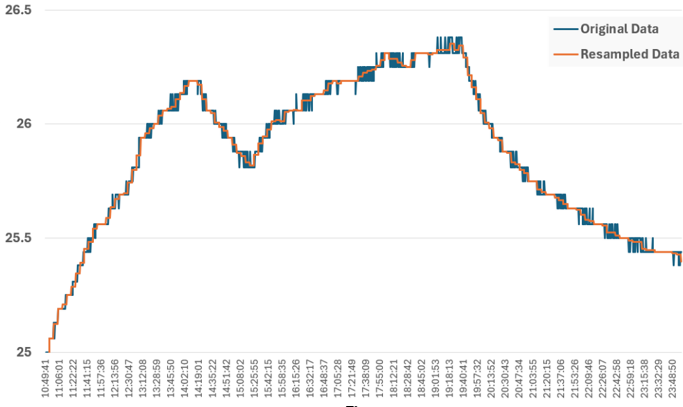
This study aims to estimate the number of people in a room using data from temperature sensors placed in a room. The study utilizes an open-source dataset comprising time-dependent temperature sensor data. The days when the number of people in the dataset was always zero were removed to avoid misleadingly increasing the success of the model, and the number of data points was reduced by averaging every 10 measurements. The temperature data were converted into RGB images of 28 x 28 pixels, and the measurements from each sensor were assigned to a different region in the image. A convolutional neural network model was trained by dividing these images into training, validation, and test sets. The model was able to predict the no-person and low-person classes with high accuracy. However, at higher headcounts, the model’s performance degraded. In particular, prediction errors increased in transition situations where the number of people changes rapidly. The accuracy of the model on the test dataset is obtained as 93.33%. The results show that temperature data can be effectively used to predict occupancy levels. This study lays a foundation for headcount prediction based on temperature data and offers significant potential in applications such as smart building systems.
Author Affiliations
- Özcan Çataltaş— Electrical Electronic Engineering Department, Selcuk University, Konya, Türkiye fingerprinthttps://orcid.org/0000-0002-7136-6574
References (17)
- 1
X. Dai, J. Liu, and X. Zhang, "A review of studies applying machine learning models to predict occupancy and window-opening behaviours in smart buildings," Energy Build, vol. 223, p. 110159, Sep. 2020, doi: 10.1016/J.ENBUILD.2020.110159.
- 2
A. P. Singh, V. Jain, S. Chaudhari, F. A. Kraemer, S. Werner, and V. Garg, "Machine Learning-Based Occupancy Estimation Using Multivariate Sensor Nodes," 2018 IEEE Globecom Workshops, GC Wkshps 2018 - Proceedings, Jul. 2018, doi: 10.1109/GLOCOMW.2018.8644432.
- 3
F. Banihashemi, M. Weber, F. Deghim, C. Zong, and W. Lang, "Occupancy modeling on non-intrusive indoor environmental data through machine learning," Build Environ, vol. 254, Apr. 2024, doi: 10.1016/j.buildenv.2024.111382.
- 4
R. Mahto and K. Sood, "Advancing Occupancy Detection through Deep Learning and Sensor Integration," 2024 IEEE 14th Annual Computing and Communication Workshop and Conference, CCWC 2024, pp. 173–177, 2024, doi: 10.1109/CCWC60891.2024.10427586.
- 5
K. Tutuncu, M. Koklu, and O. Cataltas, "Occupancy Detection Through Light, Temperature, Humidity and CO2 Sensors Using ANN." [Online]. Available: http://iraj.in
- 6
M. Emad-Ud-Din and Y. Wang, "Indoor Occupancy Sensing via Networked Nodes (2012–2022): A Review," Mar. 01, 2023, MDPI. doi: 10.3390/fi15030116.
- 7
I. P. Mohottige and T. Moors, "Estimating Room Occupancy in a Smart Campus using WiFi Soft Sensors," Proceedings - Conference on Local Computer Networks, LCN, vol. 2018-October, pp. 191–199, Jul. 2018, doi: 10.1109/LCN.2018.8638098.
- 8
K. Hashimoto, K. Morinaka, and N. Yoshiike, "People count system using multi-sensing application," International Conference on Solid-State Sensors and Actuators, Proceedings, vol. 2, pp. 1291–1294, 1997, doi: 10.1109/SENSOR.1997.635472.
- 9
L. Rueda, K. Agbossou, A. Cardenas, N. Henao, and S. Kelouwani, "A comprehensive review of approaches to building occupancy detection," Build Environ, vol. 180, p. 106966, Aug. 2020, doi: 10.1016/J.BUILDENV.2020.106966.
- 10
Z. Chen, C. Jiang, and L. Xie, "Building occupancy estimation and detection: A review," Energy Build, vol. 169, pp. 260–270, Jun. 2018, doi: 10.1016/J.ENBUILD.2018.03.084.
- 11
A. U. Nambi, A. Irawan, A. Nurhidayat, B. Humala, and T. R. Dharmawan, "Predicting room-level occupancy using smart-meter data," International Journal of Distributed Systems and Technologies, vol. 8, no. 4, pp. 1–16, Oct. 2017, doi: 10.4018/IJDST.2017100101.
- 12
B. Dong et al., "An information technology enabled sustainability test-bed (ITEST) for occupancy detection through an environmental sensing network," Energy Build, vol. 42, no. 7, pp. 1038–1046, Jul. 2010, doi: 10.1016/J.ENBUILD.2010.01.016.
- 13
Z. Yang, B. Becerik-Gerber, N. Li, and M. Orosz, "A systematic approach to occupancy modeling in ambient sensor-rich buildings," Simulation, vol. 90, no. 8, pp. 960–977, 2014, doi: 10.1177/0037549713489918.
- 14
"Room Occupancy Estimation - UCI Machine Learning Repository." Accessed: Apr. 04, 2025. [Online]. Available: https://archive.ics.uci.edu/dataset/864/room+occupancy+estimation
- 15
W. Rawat and Z. Wang, "Deep Convolutional Neural Networks for Image Classification: A Comprehensive Review," Neural Comput, vol. 29, no. 9, pp. 2352–2449, Sep. 2017, doi: 10.1162/NECO_A_00990.
- 16
A. Krizhevsky, I. Sutskever, and G. E. Hinton, "ImageNet Classification with Deep Convolutional Neural Networks", Accessed: Apr. 10, 2025. [Online]. Available: http://code.google.com/p/cuda-convnet/
- 17
N. YÜCEL and M. YILDIRIM, "Classification of tea leaves diseases by developed CNN, feature fusion, and classifier based model," International Journal of Applied Methods in Electronics and Computers, vol. 11, no. 1, pp. 30–36, Mar. 2023, doi: 10.18100/IJAMEC.1235611.